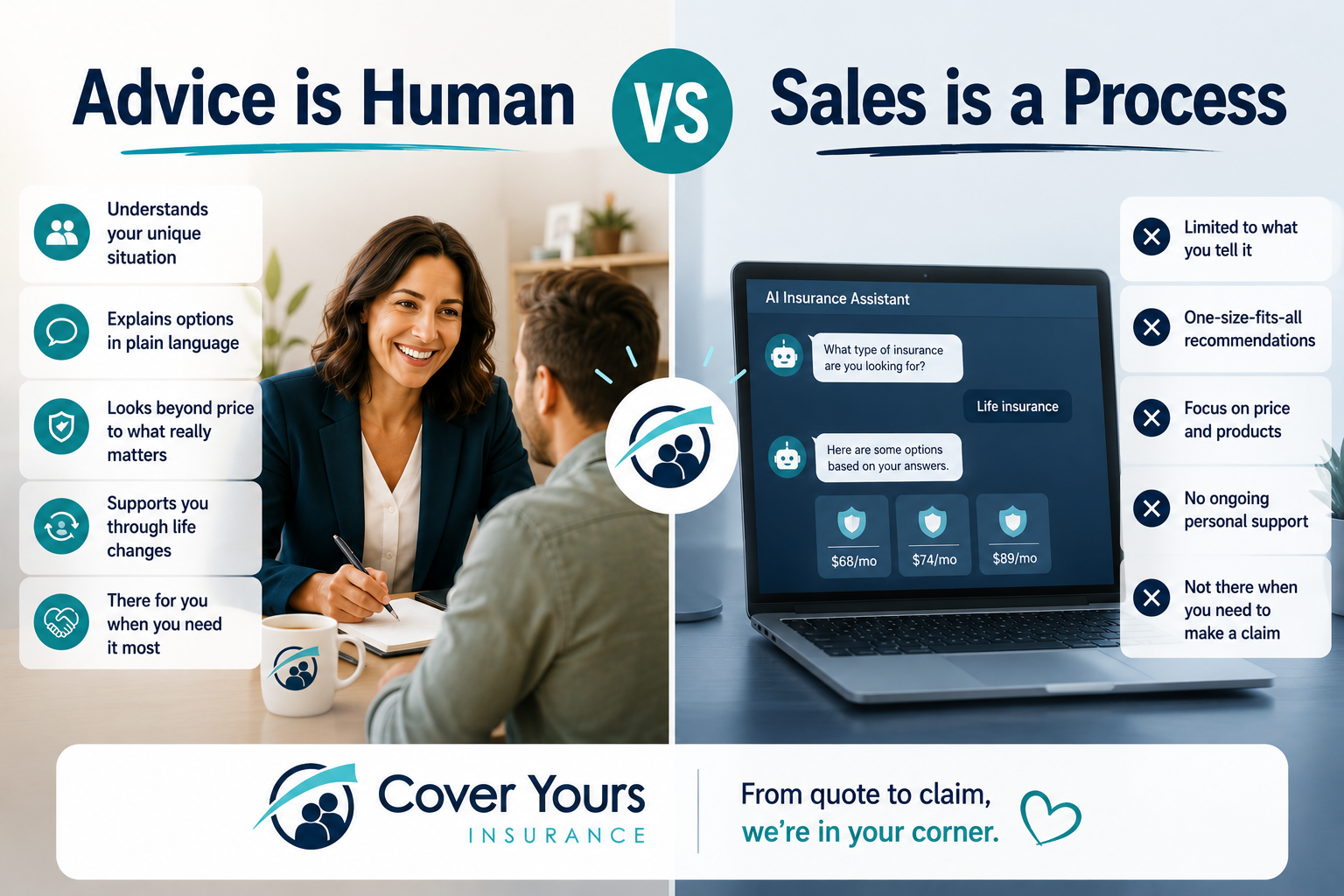
Insurance advice is not the same as insurance sales.
Advisers are focused on empowering clients to make informed decisions. Sales people are concentrating on a signature as quickly as possible.
There is a reason that high net worth individuals and those that care about their financial well-being use advisers. Those people understand the value of personal service and aftercare. They appreciate that insurance isn't a fire and forget process. Understanding it's an evolving, living document that needs to be maintained is worth the extra hour or so of their time.
Some insurance businesses are built around:
- understanding people properly
- identifying risks carefully
- giving tailored recommendations
- and supporting clients long term
Others are built around speed.
More applications. Greater volume. Uncomlicated clients. Cookie cutter approach.
Get it done quickly and move onto the next one.
The problem is that personal insurance doesn’t always fit neatly into a fast, high-volume process.
Because human beings are messy.
And real life rarely behaves like a spreadsheet.
Personal insurance is not a commodity
There’s a growing idea that insurance should work like ordering takeaway online. Answer a few questions. Tick a few boxes. Get a policy instantly.
That might work well for travel insurance, contents insurance and maybe even car insurance. But personal risk insurance is different.
Because the real question isn’t, “What’s the cheapest premium?”
It’s, “What happens financially if this person can’t work, gets sick, or dies?”
That’s a much more complicated conversation, and a much more human one. The algorithm, no matter how good, will miss the nuance.
Human needs don’t fit neatly into algorithms
AI and automation are useful tools.
They can help organise information, identify patterns and streamline admin but there’s a difference between processing data and understanding people.
Algorithms don’t understand:
- family dynamics
- emotional priorities
- business dependency
- risk tolerance
- financial pressure
- relationship stress
- or how someone actually behaves under pressure
Two clients with identical incomes on paper can have completely different insurance needs in reality. Just think about your neighbour, colleague or sibling you may have identical houses but very different lifestyles
One might have substantial family support, large savings or inheritance coming, low financial pressure and high risk tolerance. Another may be carrying extended family responsibilities, running a business with fluctuating income, supporting children or parents, and one illness away from serious financial disaster.
An algorithm willstruggle to understand that properly.
A good adviser doesn’t.
Good insurance advice can be slower
Good things take time and that’s not inefficiency. That’s care.
Proper advice takes time because someone is trying to understand the human elements of bad news:
- what risks matter most
- what cover already exists
- where the gaps are
- how policies interact
- and what trade-offs actually make sense
That process doesn’t fit neatly into scripted phone calls, templated recommendations or automated sales funnels. If it did high net worth individuals wouldn't seek out quality advisers.
Those who put value on their insurance dollar want to make sure every cent is working for them. Remember an insurance mistake often isn't obvious until years later when someone actually needs to claim. Are you willing to risk that on an AI adviser?
The danger of “cookie cutter” insurance advice
One of the biggest risks with high-volume insurance sales is that important details get missed. Sometimes accidentally. Sometimes because slowing down to explore them properly makes the process slower. Time is money.
Things like ACC, policy exclusions, benefit offsets, ownership structures, outdated cover, medical disclosure issues, business risks or sustainability and specific concerns require human consideration. A level of understanding that steps beyond an algorithm.
The uncomfortable reality is this, the fastest advice process is not always the best advice process. Particularly when the advice is designed around efficiency first and individual needs second.
Difficult clients are often where good advice matters most
This is another issue that rarely gets talked about. Most clients aren't straightforward. They may have medical history, health disclosures, unusual occupations, complex business structures or financial situations that require more careful consideration.
In a high-volume sales model, difficult cases are commercially inconvenient. Because they take more time, more underwriting, more follow-up and actual problem solving. Things an adviser loves and a salesperson hates. Many people are told they are uninsurable, they aren't. Their case is just to difficult to be commercially viable.
Good advisers tend to lean into that complexity instead of avoiding it. They know the people who need proper advice most are the ones who don’t fit neatly into automated systems.
There are a disturbing amount of clients that I have advised and organised insurance for that were told by a salesperson that they were uninsurable. Laziness is not an excuse to dismiss a diabetic or someone with high cholesterol.
Insurance advice shouldn’t end once the policy is issued
Good insurance advice is never “set and forget”.
Life changes. People have children, change jobs, start businesses, separate, take on debt,recover from illness, or develop new health conditions. Policies that suited someone last year may no longer fit properly today. That’s why regular reviews matter.
Without reviews, people can slowly drift into underinsurance or overinsurance, duplicated cover, outdated structures or policies that no longer reflect reality
This is one of the biggest weaknesses in transactional insurance sales models. Once the policy is issued, the relationship often quietly disappears.
Claim time is where advice gets tested properly
Almost everybody looks helpful during the application stage.
Claim time is different.
That’s when people find out whether they understood the policy properly; whether disclosures were done correctly; whether definitions matter and whether anyone is actually there to help. At claim time it's too late to make changes or fix mistakes.
A great adviser understands that clients are taking insurance out because they want a claim. They also know a successful claim begins at the first meeting, before the preparation of a quote. It is also in their minds that they will be the one dealing with a claim and want it to go as smoothly as possible.
Good advisers often spend significant time helping organise claims; explaining insurer requests; managing paperwork; communicating with assessors and reducing stress during difficult periods. Do you really want to be filling out 20 page claim forms with no support or advice? Especially when an error can delay a claim. That could be the diffence between an mortgage payment or selling the house.
That support can be incredibly valuable when someone is already dealing with illness, injury, or financial pressure. It’s difficult for an automated system to replicate genuine advocacy when things become complicated.
The salesman or algorithm isn't there when you are are struggling, the adviser is.
Fast advice and good advice are not always the same thing
To be fair, not every client needs an extremely detailed advice process. Some people have relatively simple needs and technology absolutely has a place in making advice more efficient but efficiency should support advice.
And where is that algorithm when you need a sympatheic ear and support with a claim? What about when you have a question? Adding a new family member or starting a new job?
Personal insurance isn’t really about products. It’s about people.
And people are nuanced. Their fears are nuanced; their responsibilities are nuanced; their risks are nuanced.
That’s impossible to reduce to a generic template or AI-generated recommendation.
What good insurance advice should actually feel like
Good advice should feel:
- thoughtful
- clear
- honest
- tailored
- and realistic
Not rushed.
Not scripted.
And not built around pushing as many applications through the system as possible.
Because the goal should be: “Make sure this policy makes sense and works when someone actually needs it.”
That’s the difference.
FAQ
What’s the difference between an insurance adviser and an insurance salesperson?
An insurance adviser focuses on understanding individual needs, risks, and long-term suitability. A sales-focused process will prioritise speed, volume, or product placement over tailored advice.
Is AI insurance advice reliable?
AI tools may help compare information or streamline processes, but they can struggle to fully understand complex personal circumstances, financial priorities, and nuanced risk situations.
Why do insurance reviews matter?
Life changes over time. Regular reviews help ensure insurance still fits current financial commitments, family situations, health conditions, and business needs.
Why can fast insurance advice be risky?
Quick processes can sometimes overlook important details like exclusions, disclosure issues, ownership structures, or policy limitations that may only become obvious at claim time.
Do insurance advisers help with claims?
Yes. Many advisers help clients navigate claims, explain insurer requirements, and assist with paperwork and communication during difficult periods.

Cover Yours insurance. From Quote to Claim we're in your corner.
Cover Yours Ltd (FSP769531) and Marc Hamilton (FSP306046) are registered Financial Service Providers and you can search the register here. Marc Hamilton is a member of the FSCL Disputes Resolution Service. Cover Yours Ltd and Marc Hamilton’s disclosures can be found here or by emailing marc@coveryours.co.nz