Sorting your own insurance isn’t automatically a bad idea. Some people have relatively straightforward needs and are perfectly capable of organising cover themselves.
But personal insurance is one of those areas where small misunderstandings, missing details or assumptions that seem harmless at the time can quietly become expensive later. At that point it can be too late to fix.
It is usually years later when health changes, work changes, or someone actually needs to claim when the mistakes come to light.
People aren’t trying to make bad decisions. They think I can do this, how hard can it be? They just want to save time, avoid complexity, cut out an adviser and get something sorted quickly. Completely understandable.
But there are mistakes that consistantly show up when people DIY life, trauma, health, or income protection insurance.
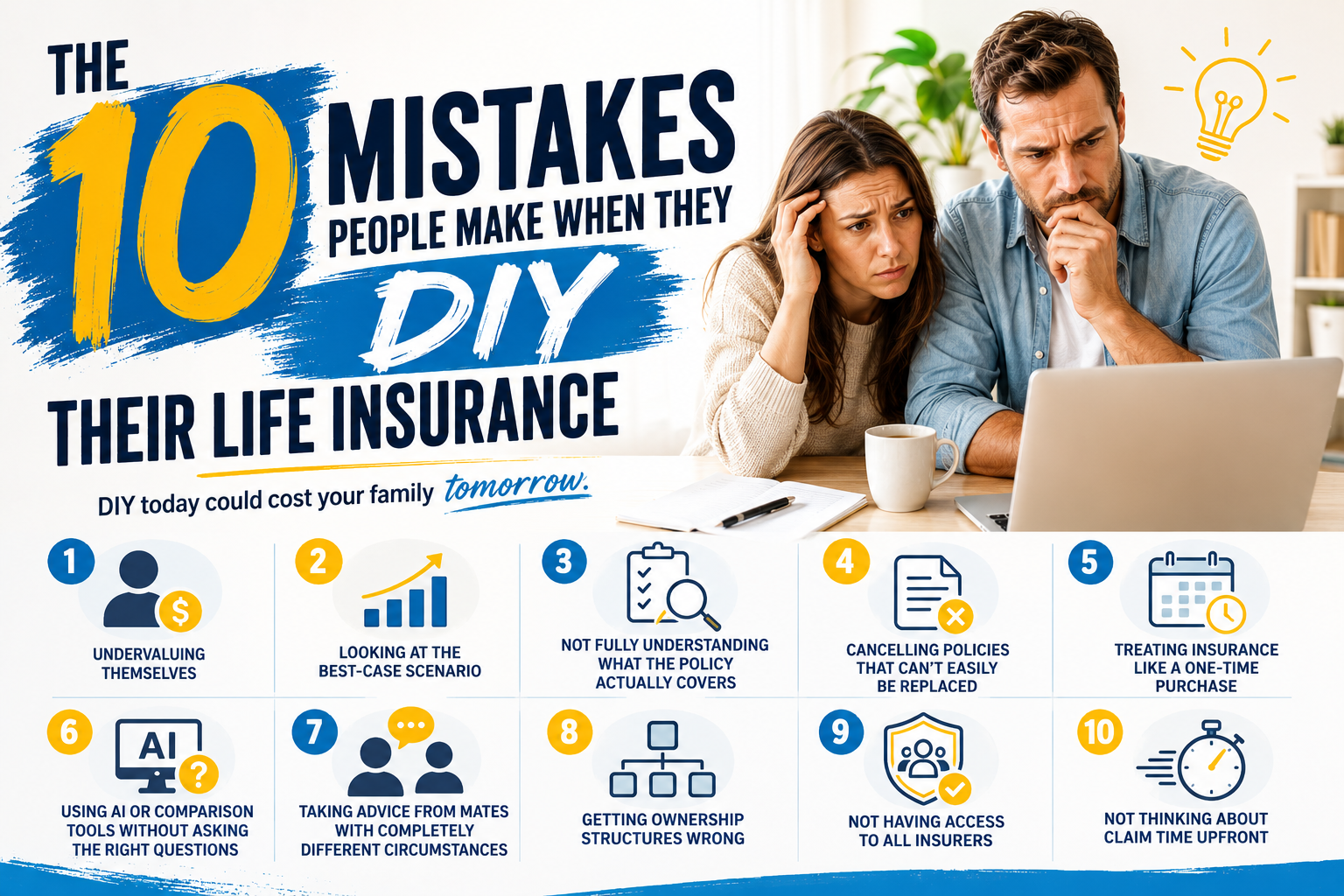
1. Undervaluing themselves
Generally people are worth more than they think, contribute more than they think and are not as financially robust as they think.
People regularly underestimate what their income is actually worth, how financially exposed the family is, how hard it would be to replace what they do and what their monthly expenses are.
The trap people fall into is thinking short term. “What do I earn this year?” rather than “What will I earn between now and retirement?”. Those are very different numbers. Especially when payrises and promotions are considered.
Then there are all the jobs they do around the home. How much time and resources go into maintaining the home, cleaning, cooking, driving the kids about, looking after children, or just looking after the garden. What will happen if one pf the adults is unable to do their share? How much will it cost to replace that 'free' labour?
2. Looking at the best-case scenario
Humans are optimistic creatures. Especially when it comes to their own future. That's why smoking, alcohol and not going to the gym are a thing.
On saying that optomism is generally a good thing but it can create blind spots around insurance.
People often assume they’ll recover quickly, savings will stretch further than they actually will, family will cope, or work will somehow continue. Reality is often messier than the version played out in our heads.
Particularly when illness, stress, or long recovery periods are involved.
Sometimes the worst does happen and that has to be considered when examining insurance options. One of my jobs as an adviser is to test these assumptions. Not to cause fear and worry but make sure that cover recommendations reflect reality.
3. Not fully understanding what the policy actually covers
This is incredibly common. A lot of people compare insurance based on price, headline benefits or what their mates said. Policy wording matters enormously.
As an adviser the number of times new clients admit they have no idea what different insurance is for or worse believe a policy does something entirely different.
Wording really matters. Two policies can look almost identical while behaving very differently at claim time. The difference between an 'and' and 'or' in a definition can be the difference in a claim being successful. Two similarly priced policies could differ with wording saying 'loss of limb' and 'loss of use of limb'. Very different conditions required for a claim.
That’s not always obvious upfront.
4. Cancelling policies that can’t easily be replaced
People sometimes cancel older policies before they have a new policy in place. This can result in stand downs being instated or a negative underwriting decision weakening a policy.
Policies are cancelled by owners in haste because premiums increase, someone online said newer policies are “better", or they assume they can simply replace the cover anytime like car insurance. But health changes matter.
A policy that was easy to obtain ten years ago may now be heavily loaded, have exclusions or be unavailable entirely. Especially if there has been surgeries, mental health history, back issues, high blood pressure, high cholesterol, diabetes, or specialist investigations.
Sometimes keeping an older policy and making tweeks is the smarter move. Don't throw the baby out with the bathwater.
5. Treating insurance like a one-time purchase
Insurance shouldn’t be a set and forget process. Because life changes.
Think about the major event that happen in everyones lives:
- buy homes
- have children
- start businesses
- separate
- reduce debt
- change income
- become financially stronger over time
Policies that suited life five years ago may not fit properly now. This is why insurance reviews matter. It's not about replacing cover but just giving it a WOF.
Those that DIY insurance tend to forget to do this, even with the best intentions. It too easily slips into the too hard basket or something more pressing comes up. It might only come to mind when it's too late and a claim is needed.
6. Using AI or comparison tools without asking the right questions
Technology is useful. Comparison tools are useful. AI can absolutely help simplify information. But tools can only work with the information and questions provided.
The phrase garbage in, garbage out comes into play here. If the right questions aren't asked, the right answers aren't supplied. The comparison tool or AI will struggle to consider the more personal and human aspects of life.
The algorithm can't pick up on indicators, hesitance and potential uncertainty that a human can. This can lead to incomplete information on risk tolerance, pressures, risks, family obligations, health situations, business exposure, and financial resilience.
Algorithms are only good at processing data that it is given. That doesn’t mean they fully understand people and their needs.
7. Taking advice from mates with completely different circumstances
This happens all the time. Someone hears a mate at a BBQ or in the bar, “I only pay $40 a month for my life insurance.” Then assumes they should have the same setup. With no understanding of much or little their mate is insured for. They aren't taking into account their age, financial situation or if they were smart enough to lock in a good price 20 years ago.
But insurance isn’t really about copying someone else’s premiums. Their mate may be under insured. At the next BBQ that same friend could be lamenting that their insurance didn't cover their needs.
Different people have different debt, different health circumstances, different responsibilities, different risk tolerance, and different priorities.
Your mate’s insurance setup may be completely inappropriate for your situation. It might even be inappropriate for their situation as they went the DIY route.
8. Getting ownership structures wrong
Ownership structures matter more than people realise.
You think all the life insurance you have will automatically go to your spouse. Maybe it will, after 6 months in probate. Perhaps it won't if an ex-partners or children are involved. The Will may say different, so might family, creditors and the IRD. Contesting a Will is expensive and drawn out. In that time what will the family do?
Is there a promise to pay back a family loan and you trust your partners to make good on your promise? Will they, if all the money arrives in their account? Will you be breaking a trust after death?
It can be even more important for business owners, trusts, and if a buy/sell agreement is in play.
Who owns the policy can affect claim payments, tax treatment, estate planning, and who actually controls the money. This is one of those areas people rarely think about until something goes wrong.
Money can bring out the worst in people, when $100,000's or millions of dollars are at stake people can change in an instant. Understand the ownership can ensure that your policy goes where it should when it matters.
9. Not having access to all insurers
A lot of major insurers don’t sell directly to the public. Not all insurances are created equally. Which means DIY buyers may only see a portion of the market.
If you were buying a house in an area would you restrict yourself to one street in a town? Would you only consider one restraunt to eat at? One destination for a holiday? Even if the prices were the same?
Even when products look similar, underwriting approaches can differ significantly between insurers. The claim records of a company matters. Policy wording can look similar but their is a big difference between "and" and "or"; "loss of a limb" and "loss of the use of a limb"; and "in our specialists opinion" and "in your specialists opinion".
It is not unusual for one company to assess a health disclosure wildly different from another. That quirk in underwriting can lead to increased premiums or exclusions and even declined insurance.
That access to other companies matters more than many people realise.
10. Not thinking about claim time upfront
Most people focus heavily on premiums, setup speed and getting approved.
Very few think carefully about “What happens if I actually need to use this?”
As has been said already wording, disclosure, underwriting, ownership and claims history suddenly matter a lot. Insurance is one of the few products where the real test often happens years after purchase. If the real test means the product fails it can't be changed.
This is when DIY insurance becomes expensive later.
The point isn’t to scare people away from DIY insurance
Some people absolutely can organise decent cover themselves.
They can:
- Live with limited public options
- Assess their financial risks
- Compare the wording
- Look at the premiums vs cover
- Accept the underwriters decision as final
- Make sure the ownership structures are fit for purpose
- Review and maintain the policies
- Go through the claim process when ill
- Trust a grieving partner to go through the claim process
It is a lot of work and there are no real benefit. The premium will be very similar, maybe even cheaper. There may be higher quality for the same price.
What would you rather do with your spare time?
Because insurance isn’t really about ticking a compliance box, owning the cheapest policy, or getting through an application quickly.
It’s about understanding risk properly, dodging avoidable mistakes, and making sure things still work when life gets difficult.
Advisers generally don't charge as they are paid a commission. We can negotiate with underwriters; understand the companies likely to look at your case favourably; watch the market for changes; give advice when needed; review policies annually; and help at claim time.
At Cover Yours Insurance, from quote to claim we're in your corner.
FAQ
Is it okay to organise life insurance yourself?
Of course it is. It might not be a good idea though. Insurance can get complicated quickly. Even a seemingly straightforward situation may be undermined with policy wording, underwriting, ownership structures, and long-term suitability.
Why do older insurance policies matter?
Older policies may contain wording no longer available that is beneficial. More likely it is underwriting terms that may not be available, if health has changed since the original application working with the old policy might be the best idea. In some cases you can increase an existing policy with no underwriting.
Can AI recommend life insurance properly?
No. AI may help explain products or compare features, but they don't fully account for individual circumstances, financial priorities, underwriting differences, or long-term suitability. If they make an error that mistake lies on the user not the software.
Why are insurance reviews important?
Are your circumstances the same now as 10, 20, 30 years ago? Life changes over time. Reviews help ensure insurance still fits current debt levels, income, family responsibilities, and financial goals.
Why does underwriting matter?
Underwriting determines how insurers assess health, risk, exclusions, and pricing. Full disclosure is important because incorrect or incomplete information can create claim problems later. Insurance companies can cancel a policy for accidentally forgetting to include a detail, they will decline a claim if a health condition is kept back - even if the doctor said it's nothing to worry about. Companies also underwrite differently, putting in exclusions or increasing premiums.

Cover Yours Ltd (FSP769531) and Marc Hamilton (FSP306046) are registered Financial Service Providers and you can search the register here. Marc Hamilton is a member of the FSCL Disputes Resolution Service. Cover Yours Ltd and Marc Hamilton’s disclosures can be found here or by emailing marc@coveryours.co.nz