Insurance has a talent for sounding more complicated than it really needs to be. We are here to add some transparency. We know half the battle is simply understanding what each type of cover actually does.
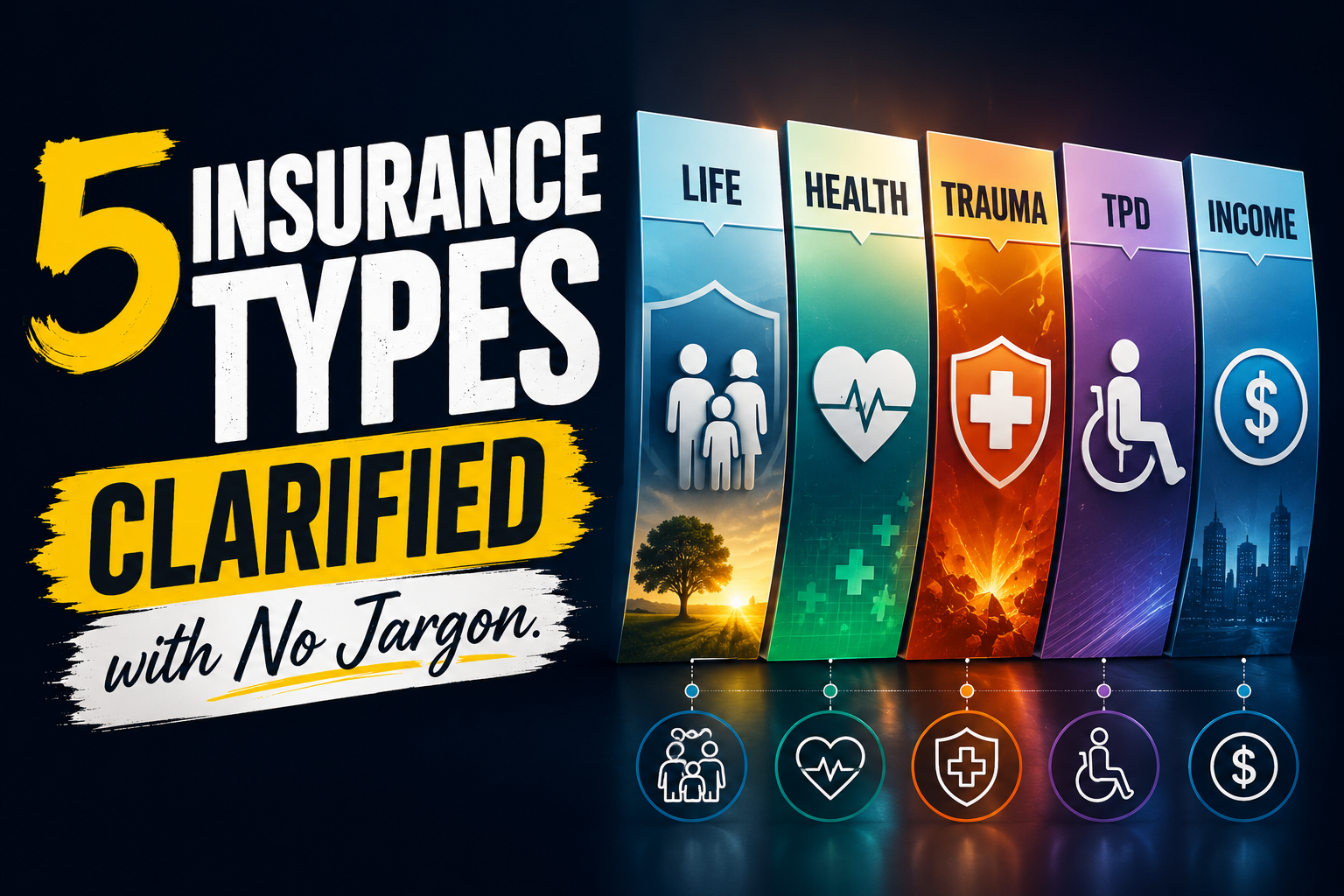
Once you strip away the jargon, most personal insurance falls into a few core categories:
- life insurance
- trauma cover
- income protection
- TPD cover
- health insurance
They all solve different problems and no, buying all of them doesn’t automatically make someone “well protected”. Cover has to be reflect the individual needs. Good insurance is usually more about getting the right mix in the right places.
Policies are not like Pokémon cards.
So here’s the simple version.
Life insurance — the “if I die” cover
Life insurance is probably the easiest one to understand. If the insured person dies, or is diagnosed as terminal, the policy pays a lump sum to the nominated owner or beneficiaries.
That money can be used for things like:
- paying off a mortgage
- replacing lost income
- supporting children
- covering debts
- giving a family breathing room financially
Insurance can’t replace a person, but it can reduce financial pressure at an already difficult time.
Example
Life insurance can make sure dreams and ambitions for surviving family don't die with the person insured. Childrens education, safe family home, retirement plans, healthy savings can all continue after death. Life insurence is a legacy when you can't afford one.
Simple idea.
Big impact.
Trauma cover - the “survive something serious” cover
Trauma insurance (sometimes called critical illness cover) pays a lump sum if someone suffers a specified serious medical event and meets the policy definition. Cancer, heart attack, stroke, loss of limbs, neurological diseases, blindness, deafness ... the list goes on. Usually about 50 listed condition are covered.
A few key things to understand.
Trauma cover isn’t designed to replace income forever. It doesn’t pay a claim for every illness under the sun. It doesn't cover the 'trauma' of failing an exam or the death of a pet.
It’s there to provide financial flexibility after major health events.
Definitions matter a lot here.
A “mild” or "minor" event may not trigger a claim under some policies. Some policies are more genrous than others with definitions of "minor". Many companies offer extension benefits with smaller claims for diagnosis or "mild" conditions. Other policies are available for only severe or limited conditions, these have a smaller premium.
That’s why wording matters far more than flashy marketing brochures and a focus on premium.
What is trauma money usually used for?
Buying time when there is the worst diagnosis. Simple as that. Time to take stock, re-orientate and re-evaluate.
- time off work for a partner to help care
- treatment costs or health insurance excess
- covering an income protection wait period
- paying for in home care
- travel and accomodation for treatment and support people
- modifying homes
- unpaid leave, retraining or additional recovery time
- paying off debt to increase life choices
Serious illness creates enough stress. Financial stress doesn’t improve the situation.
Income protection - the “if I can’t work” cover
This is often one of the more important covers for working people. 1 in 3 households wouldn't be able to continue their lifestyle after 1 month without pay. Almost everyone is heavily dependent on income continuing.
Income protection pays a monthly benefit if someone can’t work due to illness or injury. Statistically, people are often far more likely to be temporarily unable to work than to die during working years. This is why Income protection is so important.
Mortgage Cover and Expenses Cover fall into this category too. They have different wordings and claim criteria.
Important point:
Income protection is not the same as ACC. ACC only covers accidents. Additionally it only covers someone until they fit to return to the workforce, not their old job. Even if that means a pay cut.
Income protection covers illnesses as well as accident, which is where a majority of long-term absences actually come from.
Things like:
- cancer
- mental health conditions, including burnout
- chronic illness
- back issues
- surgery recovery
Wait periods and benefit periods explained
This is where policies start sounding annoyingly insurance-y. Like many boring things it is very important to understand.
Wait period is how long someone waits before payments begin. Can be as low as 2 weeks or as much as 2 years. This has an impact on the premium.
Benefit period is how long payments can continue. This can be months, years or to retirement and beyond. Longer benefit periods mean increased premiums.
There’s no universally “best” setup. It depends on savings, sick leave, and financial resilience. That's what insurance advisers help with.
TPD cover - Total and Permanent Disability insurance
This one is often poorly understood. TPD pays a lump sum if someone becomes permanently unable to work due to illness or injury.
The important word there is, permanently. This isn’t designed for short-term injuries.
TPD is usually intended for life-changing situations where returning to work becomes unlikely. Total disability is not a high risk but if it happens, it is a high needs.
Most people don't think it will happen to then but think; severe neurological injury; paralysis; major brain injury; degenerative disease; or permanent loss of function. Now think about the costs involved in re-adjusting a lifestyle. Does the house need remodelled, or sold; special equipment for mobility, communication or daily tasks; who will do all those wee jobs around the house like cleaning, D.I.Y, gardening; will there be a need for specialist in home care, councelling or regular outpatient visits.
Permamnent Disability can be more expensive financially and emotionally than a death.
Own occupation vs any occupation vs modified definitions
This part matters, it really matters. I'm not kidding, it makes a massive difference to the policy.
Own Occupation : This definition considers whether someone can return to their own, pre-disability, job. This is considered the strongest definition. Not all companies offer it for manual jobs and some occupations are exempt everywhere.
Example:
A surgeon who permanently loses fine motor function in their hands may never return to surgery, even if they could technically still work elsewhere. A calim would be consiered under an Own Occupation definition.
Any Occupation : This looks at whether someone could work in any occupation reasonably suited to them by education, training, or experience. This definition is harder to meet.
Someone may be unable to return to their previous role but still capable of working in another capacity.
Example:
A surgeon who permanently loses fine motor function in their hands may never return to surgery, even if they could technically still work elsewhere. A calim would not be consiered under an Any Occupation definition. They can still teach or work in another medical field.
Modified : Some policies use hybrid or modified versions with additional conditions or restrictions. This can be for those in a higher risk or manual occupation where an insurer feels the risk is high.
Which is why comparing wording properly matters - TPD definitions are absolutely not all the same.
Health insurance - the “vip medical treatment access” cover
Health insurance is about timely access to medical treatment when necessary. It covers the exact cost of private healthcare costs, minus any excess.
Depending on the policy, that may include:
- specialist consultations
- diagnostic testing
- surgery
- cancer treatment
- non-Pharmac drugs
- GP, nurses and vaccinations
- Optician and dentists
There are different levels of health insurance and this is where people often get confused.
Basic surgical cover
Usually focused on major surgeries and treatment costs. More affordable. Less comprehensive. Usually allows an excess of up to $10,000 to reduce the premiums.
Specialists and Tests
Genrally includes specialist consultations, diagnostics, and testing. Some companies allow a small excess here.
Primary Care Cover
This cover can be variable, it tends to be modular and some companies don't offer this cover at all.
This will pay towards day-to-day healthcare, optical, dental, physio, and wider treatment access.
What you want will depend on:
- budget
- priorities
- health history
- what someone actually values
Some people mainly want access to faster surgery, they are happy to pay for the every day medical treatments. Others care more about comprehensive ongoing healthcare support.
Specific injury benefits
Some policies include specific injury or fracture benefits as optional add ons to income protection. Other companies offer it as a stand-alone option.
These can provide predefined lump sums for certain injuries such as:
- fractures
- operations under general anaesthetic
- loss of function
- other specified accidental injuries
They’re generally designed for quicker, simpler claims in clearly defined situations. Useful in some cases. Usually not the core reason people hold broader personal insurance, a nice to have. Maybe more important for some hobbies and industries.
So… which insurance is most important?
Annoyingly:
it depends.
People’s lives are different. Peoples needs are different.
Even if lives look similar on the outside the financial needs, appetite for risk and support networks can be worlds apart.
This is why an independent adviser is so crucial when it comes to organising insurance.
Good insurance planning is usually about identifying:
- where the financial risks are
- what would genuinely hurt
- and what trade-offs make sense
Not simply buying every policy available.
There’s no trophy for having the most insurance.
The real purpose of insurance
Insurance can’t prevent bad things from happening.
It can’t cure cancer.
Undo an injury.
Replace a person.
What it can do is provide options when life becomes difficult.
And financially, options matter.
A lot.
Providers We Work With
At Cover Yours, we work with a wide range of providers depending on client needs, underwriting requirements, policy structure, and suitability.
- AIA
- Partners Life
- Fidelity Life
- nib
- Southern Cross
- Asteron Life
- Resolution Life
- Chubb Life
- Unimed
We don't push one provider. We find the right fit for the client’s situation.
FAQ
What is the difference between trauma and income protection insurance?
Trauma cover pays a lump sum after specified serious illnesses or injuries. Income protection pays an ongoing monthly benefit if someone cannot work due to illness or injury.
Is TPD insurance the same as life insurance?
No. Life insurance pays after death. TPD insurance may pay if someone becomes permanently unable to work due to illness or injury.
What does health insurance cover in New Zealand?
Health insurance may help cover private medical treatment, specialist consultations, diagnostics, surgery, and other healthcare costs depending on the level of cover selected.
What is own occupation TPD?
Own occupation TPD assesses whether someone can return to their specific profession or job, rather than any job at all.
Does ACC replace income protection?
No. ACC covers accidents. Income protection also cover illnesses, which are a common cause of long-term work absence.

Cover Yours Ltd (FSP769531) and Marc Hamilton (FSP306046) are registered Financial Service Providers and you can search the register here. Marc Hamilton is a member of the FSCL Disputes Resolution Service. Cover Yours Ltd and Marc Hamilton’s disclosures can be found here or by emailing marc@coveryours.co.nz